
On 1 April, an AFI Peer Learning Exchange brought together staff from the central banks of Jordan and Sudan, to discuss the institutional governance and coordination mechanisms required to bring financial inclusion policy objectives to life.
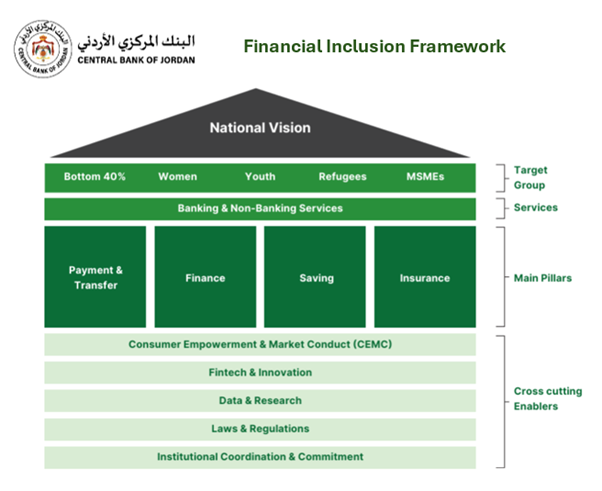
The Central Bank of Sudan (CBS) is currently preparing the groundwork for a national financial inclusion strategy, and was keen to learn from the Central Bank of Jordan’s (CBJ) experience. In recent years, CBJ has increased overall financial inclusion from 33% to 43% and slashed the financial gender gap from 53% to just 22%. Their strategy has a strong focus on marginalized groups, including women, youth, refugees, and small businesses.
During the exchange, CBJ experts emphasized the value of a data-driven approach, including using supply- and demand-side surveys to inform policy interventions. They shared their experience in establishing a Financial Consumer Protection department, and in introducing mandates for transparent complaint-handling processes, regulations ensuring accessible physical and digital services for persons with disabilities, and a “Basic Bank Account” which eliminates minimum balance requirements.
CBJ shared its experience in conducting national diagnostic surveys, outlining how central banks can align their internal methodologies with existing World Bank Global Findex data or partner directly with national statistical bureaus to gather insights efficiently. CBJ also shared operational blueprints for institutional governance, detailing how high-level steering committees and technical working groups serve to maintain cross-ministerial alignment.
“Formulating and executing national policy reform is a complex undertaking,” said AFI’s Regional Manager for EECA and Arab Region, Arif Nasibov. “By sharing the mechanics of their regulatory framework and the realities of their implementation, CBJ provided CBOS with an actionable roadmap. Today’s exchange emphasizes the value of leveraging peer experience as a way to overcome common hurdles and accelerate the creation of more inclusive and resilient economies.”