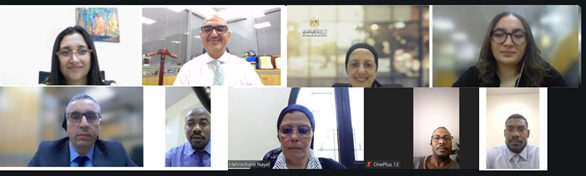

On 14 April, an AFI Peer Learning Exchange between Central Bank of Egypt (CBE) and Central Bank of Sudan (CBOS) explored best practices in data-driven policies, and in promoting consumer protection, entrepreneurship, and digital financial services.
Under Egypt’s first (2022-2025) National Financial Inclusion Strategy, which had a strong focus on women, youth and small business, the financial inclusion rate rose to 77.6% by 2025. During the exchange with their CBOS colleagues, CBE experts emphasized the value of a data-driven approach, including the use of supply- and demand-side surveys to identify gaps and inform policy interventions, and the use of gender-disaggregated data to take targeted action on women’s financial inclusion.
The CBE staff discussed the importance of a “customer-centric” philosophy, which includes designing financial products for youth that align with their digital lifestyles. They shared details of NilePreneurs, an initiative launched by CBE in collaboration with the Egyptian banking sector and Nile University, which seeks to create a supportive environment for entrepreneurship by providing advisory, technical, financial, and non-financial services to startups and SMEs.
The CBE team discussed their transformation into a “less-cash” society, where digital payments and fintech solutions are prioritized to increase transparency and accessibility. They also shared their experience in establishing a Financial Consumer Protection department, highlighting the importance of robust grievance mechanisms which every citizen can access.
“I would like to thank the Central Bank of Egypt for sharing your rich experience in the implementation of financial inclusion, starting with the development of your national policy,” said Fatima Ahmed Mohamed Bashheer, General Director for Financial Inclusion at the Central Bank of Sudan.
“Today’s exchange was very insightful,” said Arif Nasibov, AFI’s Regional Manager for the Arab Region, Eastern Europe, and Central Asia. “By sharing the mechanics of their regulatory framework and implementation examples like NilePreneurs, CBE has provided CBOS with an actionable roadmap. This exchange emphasizes the value of leveraging peer experience to overcome common hurdles, and to accelerate the creation of more inclusive economies.”
AFI is very grateful to the CBE team (Sally Abdel Kader, Khaled Bassiouny, Heidi El Fadly, Mehrechane Nayel, Ramy Galal, Reham Amin, Rasha Yousry, Hani El-Banhawy, Mohamed Fayez and Ayman Elsaeed), who contributed their insight and expertise.