
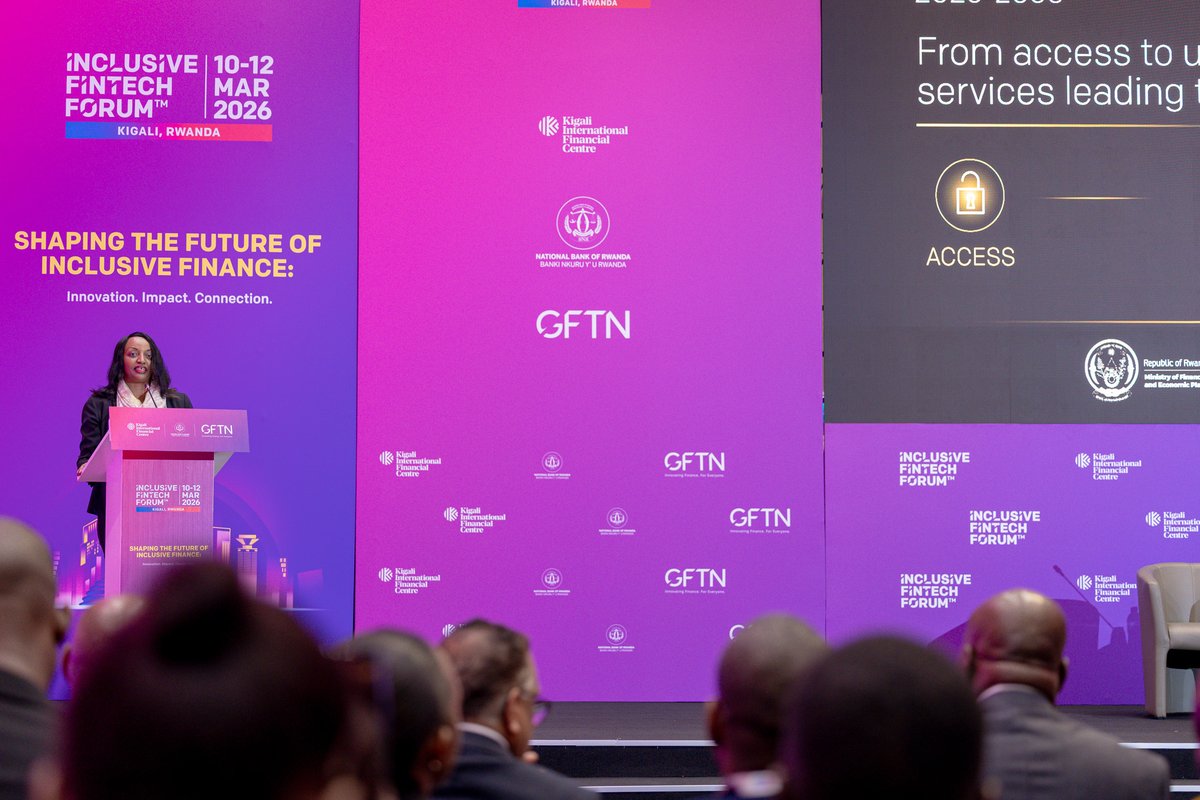
On 10 March, during the Inclusive Fintech Forum (IFF) in Kigali, Rwanda launched its National Financial Inclusion Roadmap 2026-2030.
Jointly led by the National Bank of Rwanda (NBR) and the Ministry of Finance and Economic Planning, the NFIR aims to extend digital financial services, and build financial resilience, for individuals, households, farmers and MSMEs, and to strengthen financial health for the whole population.
“Rwanda has made remarkable progress in expanding financial inclusion, yet important gaps remain in meaningful usage and financial resilience,” said NBR Governor and AFI Board Chair, Soraya M. Hakuziyaremye. “The roadmap responds to these challenges by shifting Rwanda’s focus from financial access to financial health, in line with the shared goal of building long-term economic resilience and shared prosperity.”
“This roadmap is, at its core, a promise: that as Rwanda continues its journey to become an upper‑middle‑income economy by 2035 and a high‑income economy by 2050, no Rwandan will be left behind because they lacked the right financial tools.”
During the IFF, AFI’s Africa Region Head, Nomcebo Sherron Hadebe, spoke on a panel exploring how regulators can lead in advancing financial inclusion. “If we want to measure household resilience, we must first build the capacity of regulators and institutions to measure it properly,” she highlighted. “A global household index could help, but only if we remain intentional about what we measure, because with standardization we risk missing the real nuances of people’s lives.”
Bringing affordable finance to farmers, digitally
The IFF also saw the launch of a pilot for a Rwandan national agricultural lending infrastructure, designed to connect smallholder farmers, financial institutions, and agricultural value chains through shared digital rails. The initiative will use data-driven credit models and interoperable digital platforms to expand access to affordable finance to a sector that employs over 60% of the population, but which remains largely underserved by formal financial institutions.