

Md. Rabiul Islam, Assistant Director, Microcredit Regulatory Authority
While financial inclusion debates in Bangladesh have largely focused on banks, the microfinance sector has demonstrated a level of repayment performance the banking sector has yet to match.
According to Bangladesh Bank’s latest quarterly report, the banking sector has an NPL ratio of 32.3 percent, equivalent to USD 47.58 billion out of USD 147.42 billion in total loans outstanding. In contrast, the microfinance sector’s NPL stands at 8.5 percent, or USD 1.20 billion out of a total outstanding loan portfolio of USD 14.13 billion (Microfinance in Bangladesh, June 2025). Microfinance institutions (MFIs) classify a loan as non-performing after it is overdue by more than one month, which is much stricter than the standard applied in the banking sector.
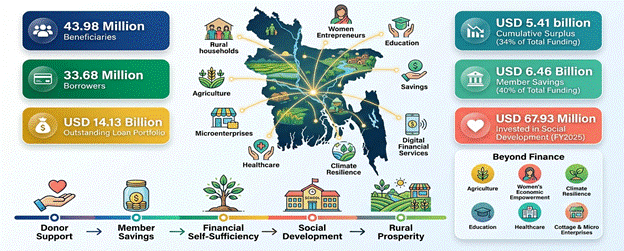
As of June 2025, microfinance institutions have served 43.98 million beneficiaries and 33.68 million borrowers. Borrowers are mostly day laborers, small traders, and marginal women, who are the most vulnerable to economic or climate shocks.
MFAs are the main source of finance for the rural economy. MFIs disbursed USD 8.93 billion in CM (cottage and micro enterprise) lending in FY2025, alongside roughly USD 11.14 billion in agricultural lending, both without collateral. To put this into context, as per the FSR of Bangladesh Bank, outstanding agricultural loans were USD 5.70 billion, while loans to the CMSME sector amounted to USD 2.32 billion as of December 2025.
As nonprofit organizations, MFIs retain their surpluses rather than distributing profits to owners. MFIs had accumulated a cumulative surplus of USD 5.41 billion as of June 2025, which accounted for 34 percent of the total fund. Out of USD 16.16 billion in total funds, members’ savings accounted for 40 percent, or USD 6.46 billion.
The MFI sector relies primarily on internally generated resources and member savings over external donor funding. Bank financing for MFIs was around USD 1.78 billion, while MFIs had deposits of USD 1.09 billion in banks as liquidity and reserve funds. Donor funds account for only 0.17 percent of total MFI funds, and MFIs are expanding their sources of funding through bonds, hedge funds, and foreign loans in local currency.
The evolving role of microfinance
As for whether agent banking and mobile financial services (MFS) will replace the traditional microfinance model, data suggests that they continue to serve largely distinct functions. MFS providers, most of which operate as extensions of banks, remain concentrated on basic transactions and small-value lending, offering savings and loans under banks or NBFIs, not under the MFS providers themselves.
For agent banking, between 2018 and 2025, average deposits have been USD 1.94 billion, while loans and advances have been USD 38.53 million, which is less than two percent of deposits. MFIs, meanwhile, have expanded their lending ceilings considerably to small and medium businesses, where they have instances of lending USD 50K collateral-free, like other small loans.
Microfinance plays a key role in financing development projects – they can spend 20 percent of their previous year’s surplus for poverty alleviation with the prior approval of the Microcredit Regulatory Authority. In FY2025, MFIs spent USD 68 million on social development work, with the highest allocations directed towards climate-vulnerability rehabilitation (USD 23 million), education (USD 20 million), and healthcare (USD 15 million). Given the shortfall created by the reduction in USAID assistance, MFIs are well placed to take on social and economic opportunity-related projects.
As MFIs have been working with marginal people for many years, the government can take information and administrative support from MFIs to identify and formulate government social safety net programs, as MFIs hold ground-level data on household economic conditions.
Examining the microfinance charge burden
Concerns remain about the relatively high interest rates charged by MFIs. Bank lending rates (excluding credit cards) average 14.5%, whereas MFI service charges are capped by the regulator at 24%, which is justified by their high-touch and door-to-door service. For the 20 largest MFIs, which have lower operational costs and which account for 74 percent of the total loan portfolio, even if they were given a 4 percent spread over their operational costs, it would not exceed a 21 percent interest rate. Therefore, MRA could introduce a tiered service charge regulation based on institutional size and operating cost, without affecting smaller institutions serving harder-to-reach clients.
Overall, the evidence suggests that microfinance fills the areas underserved by conventional banking, and supports financial inclusion. It remains relevant despite the emergence of digital financial services, which have been embraced by some MFIs. By rationalizing the customer service charge burden, and providing concessional funding through refinance and wholesale funders, we can maximize the effectiveness of the microfinance sector and take advantage of its social development work for the betterment of society.