
Pakistan’s financial system has, for decades, worked perfectly well — just not for its women. The State Bank of Pakistan is on a mission to change that from the inside out.
Pakistan is a country of over 240 million people, and women make up roughly half that population. Yet when you look at how many of them are actually participating in the formal economy, the number is sobering: only 24% of working-age women are in the active labor force. The rest are contributing informally, invisibly, and without the financial tools that could change the trajectory of their lives and the lives of their families.
It is not a mystery why.
Let’s take an example of a woman I know, whose name is Farzana. A mother of two young kids, Farzana runs an embroidery business in Multan. She’s a natural entrepreneur, and committed to making her family more financially stable. But when she wanted to expand into stitching to increase her income, she faced significant challenges:
- How to overcome social and cultural norms, shaped by her community, neighbors, husband and relatives, that dissuade women from working?
- How to know what kind of financial services were suitable for her needs?
- How to actually get to a bank branch? (In Farzana’s case, she had to arrange for childcare, and ask her brother to take her on his motorbike)
- How to provide the bank with documents and assets in her name, when she didn’t have any?
In order to achieve something that most of us take for granted – opening a bank account – Farzana would need to resolve multiple issues: her family’s permission, a safe way to travel, the need for documentation, and the quiet hope that when she finally sat across from a bank employee, she’d be taken seriously.
For a man, those hurdles barely exist.
Our policies and regulations are predominantly shaped by gender neutrality principles – which sound fair, but in reality are a polite way of ignoring the gender inequalities in our system. Research and international best practices have shown that countries that don’t recognize and try to fix the ongoing gender inequalities in society, are unable to see real progress or growth in the future.
Building gender-intentional policy from the ground up
For years, Pakistan’s financial inclusion strategies improved overall account ownership — but when you disaggregated the data by gender, men’s accounts were growing far faster than women’s. The gap was not closing; it was just being obscured. As the only woman in my department, and a feminist at heart, these trends kept nagging at me, prompting me to highlight it wherever I got a chance. I was fortunate to get the opportunity to work on a blueprint for a new gender policy, and even more fortunate to get buy-in and support from my seniors and peers to take it national.
In 2021, after two years of research and stakeholder consultation, the State Bank of Pakistan launched Banking on Equality, the country’s first dedicated gender mainstreaming policy for the financial sector. It set hard, mandatory targets rather than aspirational ones to move from “pink-washing” towards demand-centered, intentional product design for women.
Banks were required to bring more women onto their boards, staff, and branchless banking agent locations, and to train all staff in gender sensitivity. They were instructed to appoint a trained “women champion” in every branch — a person whose job was to make sure every woman who walked through the door was treated with dignity and had someone to turn to. Crucially, banks had to start collecting detailed gender-disaggregated data for regular reporting to SBP – one of our more alarming discoveries had been how little of this existed.
What three years of implementation looks like
- 52% of women with bank accounts — up from just 11% in 2015
- 10% drop in the financial inclusion gender gap since 2021
- 47% Increase in women hired across Pakistan’s banking sector
- 15 million unique accounts opened by women
Each one of those 15 million accounts represents a woman who now feels empowered, and who has agency to start a business, begin an investment plan for their children, invest in themselves, and invest in the future of our country.
It’s encouraging how far the ripple has traveled. National agencies like the Telecommunication Authority and the Securities & Exchange Commission, which had long been comfortable with gender-neutral policy, have now introduced their own gender mainstreaming strategies. Pakistan has joined the World Bank-led WE-Finance Code, a 23-country commitment to close the gap in women’s access to credit — because while account ownership has made remarkable progress, financing for women remains the next frontier to tackle.
Where do we go from here?
Already developed and soon to be launched, Banking on Equality 2.0 (BoE 2.0) aims to further reduce Pakistan’s gender gap in financial inclusion to 25 percent by 2028. Its priorities include:
- Increasing women’s representation in the financial sector workforce
- Expanding digital access to financial services through simplified accounts and technology-driven solutions
- Promoting women’s entrepreneurship and financial literacy through dedicated support hubs and partnerships
- Strengthening the use of gender-disaggregated data for monitoring and accountability
Through stronger public-private collaboration and targeted reforms, BoE 2.0 seeks to create a more inclusive financial ecosystem that supports women’s economic empowerment and contributes to broader national growth.
Just a decade ago, only 11% of Pakistani women had a bank account. Today that number stands at 52%. The gender gap has been on a downward trend ever since Banking on Equality was launched. Clearly, shifting the financial system from gender neutrality to gender intentionality works. The work is far from over, but the direction is clear, the momentum is real, and for 41 million women who now have a financial identity of their own, their agency is already tangible.
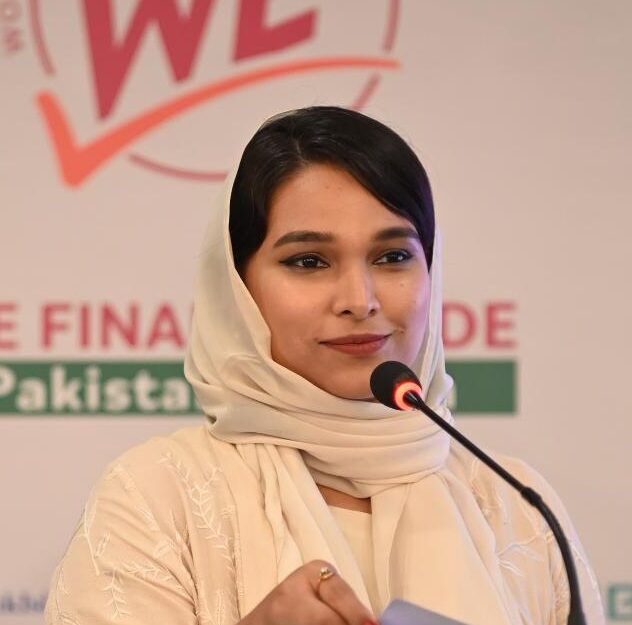
This article has been adapted from Faiqa Naseem’s talk at Wow Pakistan in January 2026, available to view below.