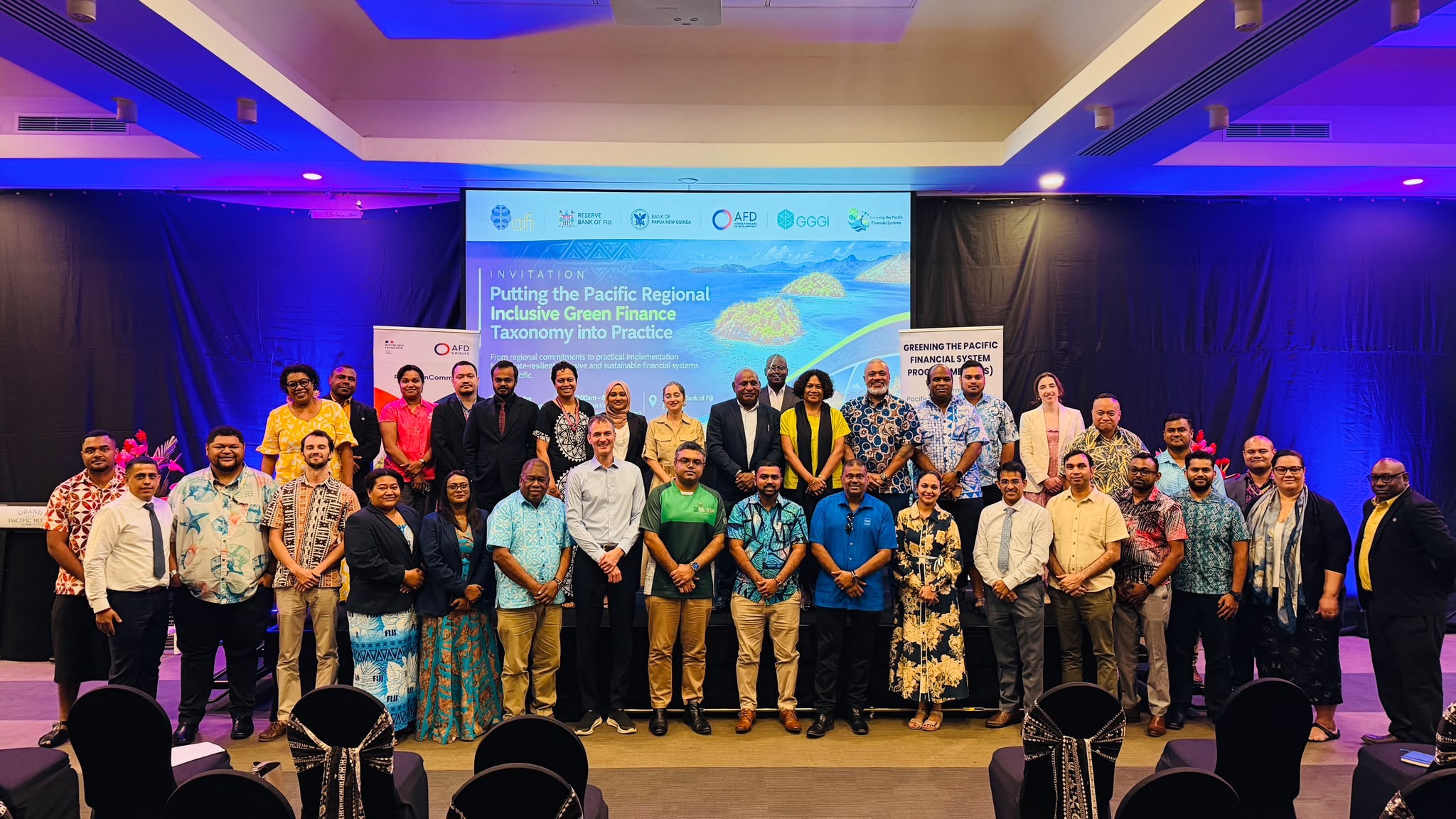
On 9 October, Pacific central banks, financial institutions and development partners met in Suva, Fiji, to move the Pacific Regional Inclusive Green Finance (IGF) Taxonomy from endorsement to implementation.
The pre-COP31 side event helped participants define the new taxonomy’s impact on IGF data reporting, lending classifications, pilot programs, and existing national taxonomies.
Co-hosted by the AFI, Reserve Bank of Fiji, the Bank of Papua New Guinea, Agence Française de Développement and the Global Green Growth Institute, the event also explored how the taxonomy will drive last-mile access to credible green lending products and services.
Launched in 2025 by Fiji, Papua New Guinea, Samoa, Solomon Islands, Tonga and Vanuatu, the regional taxonomy gives central banks and financial institutions a shared framework to classify IGF activities, improve reporting, and develop green financial products for the region’s climate-vulnerable populations.
“The taxonomy’s success will not be measured by publishing a classification system,” said AFI’s Director of Policy Programs and Implementation, Eliki Boletawa. “It will be rated by its real-life impact.”
AFI’s Pacific Islands Regional Initiative (PIRI) has “led and helped shape” the network’s IGF agenda, he explained. The new taxonomy could become a global “flagship example” of how members work collectively on IGF implementation while “retaining strong national ownership”.
The taxonomy aligns with PIRI’s and the wider AFI network’s existing commitments. In 2024, PIRI leaders endorsed the Natadola Roadmap, and this September, AFI launched the Port Moresby Compact on Inclusive Green Finance, a collective call and a global commitment to move IGF policy to implementation.

News
Pacific puts regional green finance taxonomy into practice