
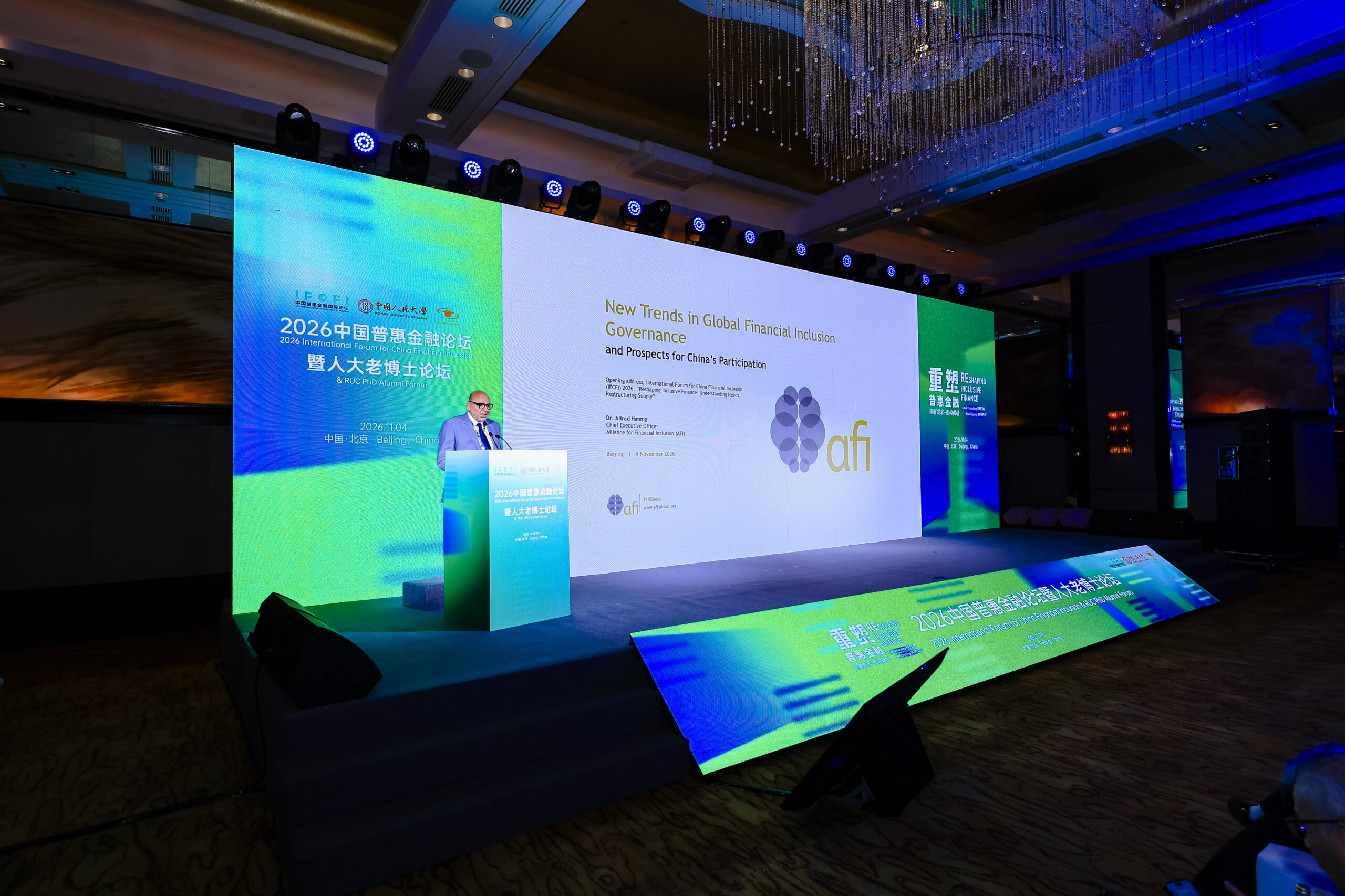
This past week in Beijing, AFI CEO Dr. Alfred Hannig joined policymakers, regulators, researchers, and industry leaders at the International Forum for China Financial Inclusion (IFCFI) 2026, organized by the Chinese Academy of Financial Inclusion (CAFI).
This year’s forum focused on moving beyond access to improving service quality, stakeholder coordination and financial health, a priority shared by AFI’s 89 member institutions.
Dr. Hannig delivered the opening address on 4 November, speaking on new trends in global financial inclusion governance and the prospects for China’s participation. He described next-generation financial inclusion as moving from access to impact, financial health and inclusive prosperity. He underlined that the increasing importance of financial health is a reflection of the financial inclusion trajectory, moving from payments to financial intermediation.
“For China, where access is now widespread, the focus is shifting from mobilizing savings to intermediating it well, so that lending reaches micro, small and medium enterprises (MSMEs) and consumer credit fits people’s needs,” Dr. Hannig noted.
Dr. Bei Duoguang, founding president of CAFI at Renmin University of China, suggested financial health is the test of whether inclusive finance works:
“An important question is whether inclusive finance has genuinely improved the operational efficiency of micro and small businesses, strengthened their risk resilience and financial resilience, and generated tangible benefits in terms of output, income and employment. These are key indicators of its effectiveness and lie at the heart of financial health.”
Financial health was also the focus of Dr. Hannig’s remarks at the 3 November thematic luncheon. He highlighted that financial health has been an ambition of the AFI network for almost a decade, and more than ten AFI members have already built financial health objectives into their national strategies, reflecting the central role of peer learning in AFI’s work and partnerships.
“Our Chinese partners see AFI as a great platform for exchanging knowledge and for understanding the regulatory environments, consumer protection standards, and sovereign financial stability priorities of developing and emerging economies. Collaboration between AFI and CAFI can help ensure that this global engagement is systematic, sustainable, and mutually beneficial.”