
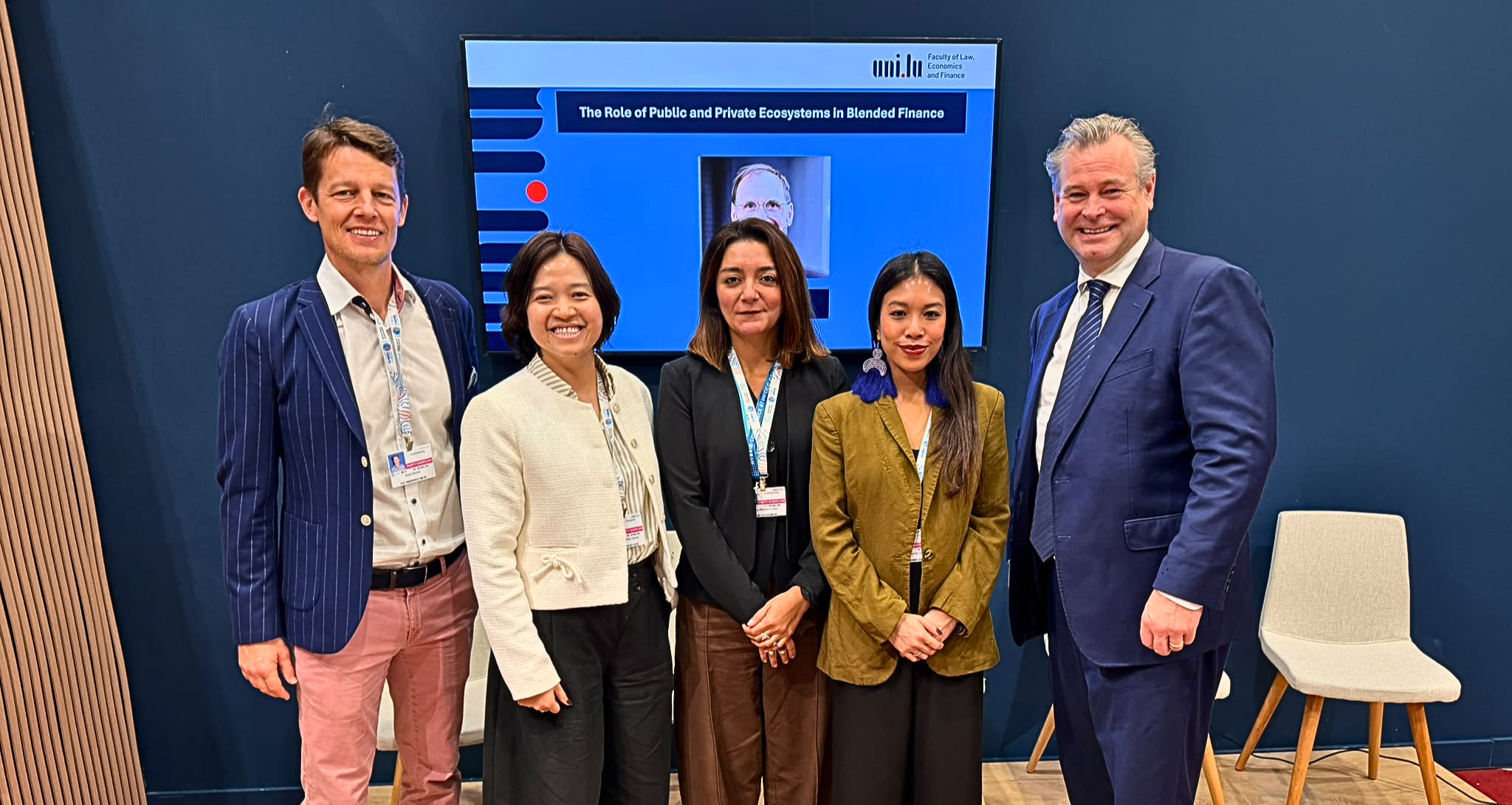
On 19 November, AFI joined a BENELUX-EIB panel discussion at COP31 in Antalya, Turkey, on how capacity building can advance blended finance – a key driver of Inclusive Green Finance (IGF).
Organized by the University of Luxembourg, the session explored how academic expertise, capacity building, and private capital can jointly unlock sustainable investment to deliver lasting environmental, economic and social benefits to emerging markets and developing economies (EMDE). Panelists included representatives from AFI, LuxDev, ADA, the University of Luxembourg, and EY.
“At AFI, our work involves working with EMDE central banks to design and implement policies that maintain financial stability while protecting vulnerable people and MSMEs against climate impacts,” said AFI Policy Specialist and panelist Mariam Zahari. “This is a key priority of AFI’s Inclusive Green Finance (IGF) workstream, which helps member institutions expand access to savings, credit, and insurance for climate-vulnerable communities.”
The IGF workstream offers peer learning, policy development, and implementation support for climate adaptation, resilience, and low-carbon development.
“But we cannot do it alone,” Zahari added. “If we want to move from policy to impact, we need to do this as a collective, and blended finance is a logical way to do it.”
She shared successful examples from AFI member institutions, including the Bangko Sentral ng Pilipinas, which helped set up an 18-member national Inter-Agency Task Force to establish a Blended Guarantee facility for MSMEs. Implemented by domestic financial institutions, the initiative uses catalytic funding to lower lending risks and expand credit to climate-adaptive MSMEs.
AFI recently launched the Port Moresby Compact on Inclusive Green Finance, a voluntary, non-binding framework endorsed by AFI members and partners to move IGF from commitment to implementation.